
What is inside

Nine calculators,
three groups

The app groups them the way the questions arrive: what your work pays, what the state pays, and what money costs. Each one below says what it asks for, what it gives back, and where its rules come from.

Salary and taxes

Three calculators about earned income. All of them work the same way: you type what you know, and the result is a breakdown rather than a single figure, because the interesting part is which line moved.

Salary and payroll tax

Net and gross, for twelve tax periods

The main calculator, and the reason most people install the app. One amount goes in and twelve results come out: every tax year from 2016 to 2026, with 2022 split into its first and second halves because the rules changed in the middle of it.

  • Both directions. Gross to net answers what lands in your account; net to gross answers what has to be written on the contract for a given sum to land there.
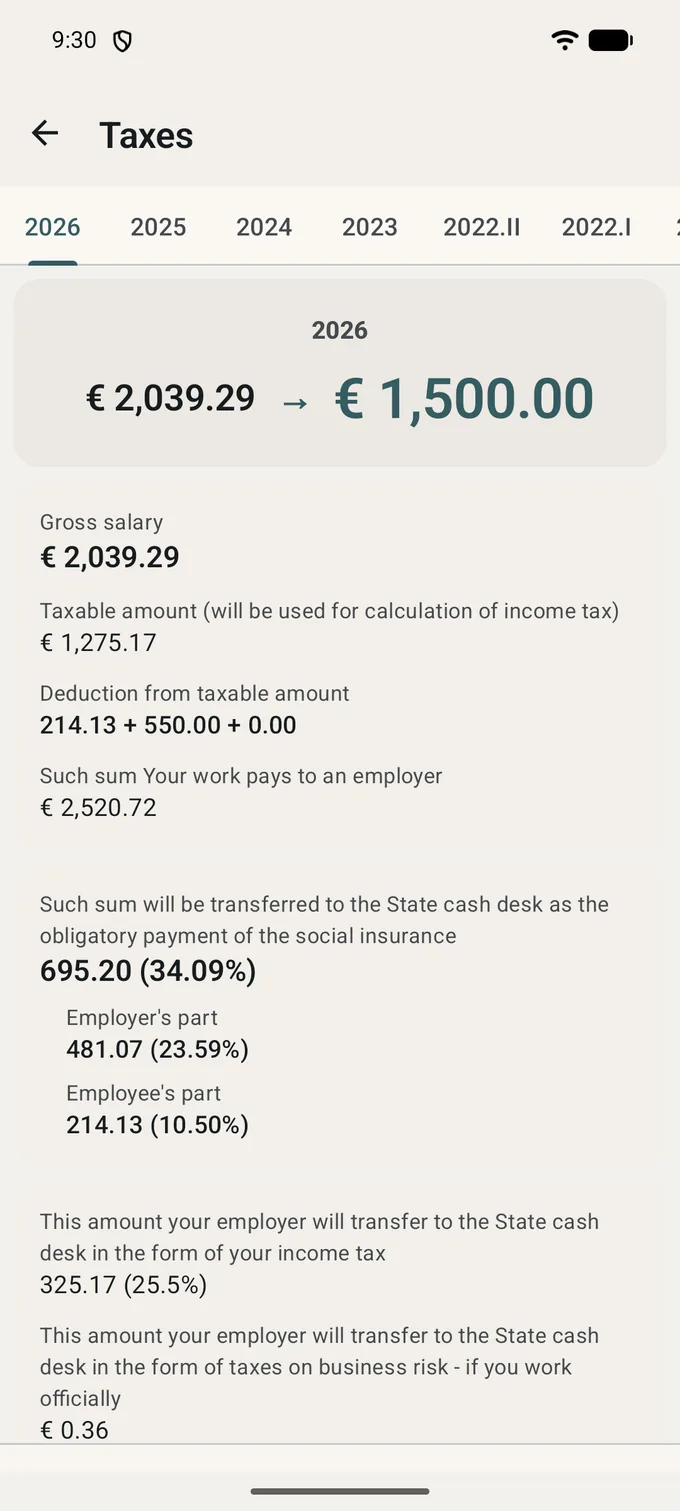
  • The result separates the income tax, the employee's and the employer's social contributions, the risk duty and the taxable base, instead of showing one deduction.
  • The periods are tabs above the result: the same input, one tap to the next year, so a reform reads as a number rather than as a headline.
  • The cases are on the input screen: tax book and the non-taxable minimum, pensioners of several different kinds, dependants, disability groups, self-employment, income from letting, non-residents, and the deduction from a prisoner's earnings.
  • If the VID has told you your personal non-taxable minimum, you can enter it and the app will use your figure rather than estimating one.

Vacation pay

Average earnings over six months, not last month's salary

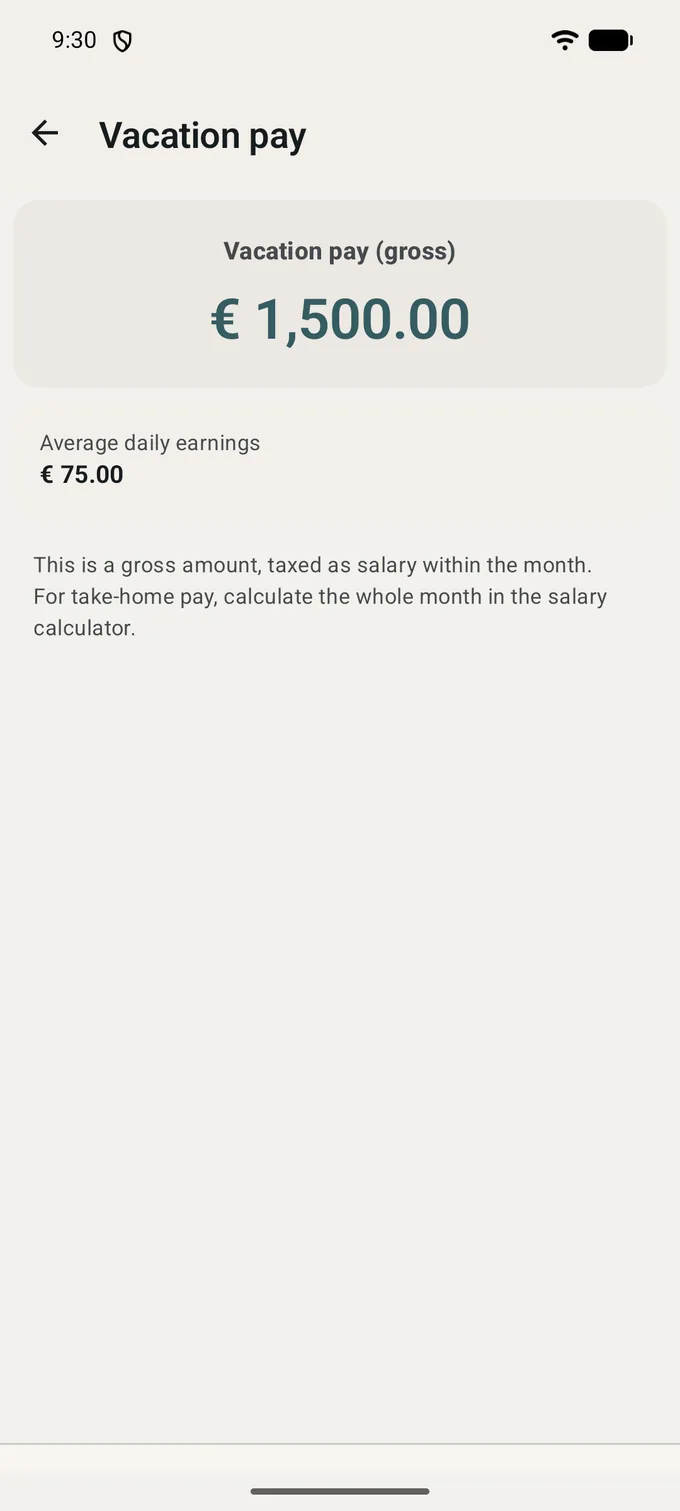
Vacation pay in Latvia is average earnings over the last six calendar months multiplied by the paid vacation days you are taking. The trap is the divisor: it is the days or hours you actually worked, so sick leave, previous vacation and justified absences come out of it.

  • Three work-time modes, because they divide by different things: ordinary days, hourly pay, and summarised working time.
  • The base is salary plus allowances plus bonuses over the six months, which is usually more than the number on the contract.
  • You enter what you actually worked. That is the figure people get wrong when they try this by hand, and it is why the result differs from a rough estimate.

Microenterprise tax: 25% of turnover, and the thresholds that end it

The microenterprise tax is charged on turnover, not on profit: expenses are not deducted, which is what makes it simple and what makes it expensive above a certain point. Turnover goes in; the tax and the amount left after it come out.

  • Above 50,000 EUR of annual turnover the app flags that a VAT registration obligation may arise, and that it may be deferred to the end of the calendar year.
  • Above 55,000 EUR it flags that registration is required and that microenterprise status may be lost from the next tax period.
  • Both warnings are about your obligations, not about the arithmetic. The tax itself is one multiplication; the thresholds are the part worth being told about.

Benefits

Four payments made by the State Social Insurance Agency. They share a shape: none of them is calculated from the salary on your contract, and all of them are calculated from the base on which social contributions were actually paid, over a period the law defines. That gap is why estimating them in your head goes wrong.

Parental benefit

Paid on contributions, not on the contract

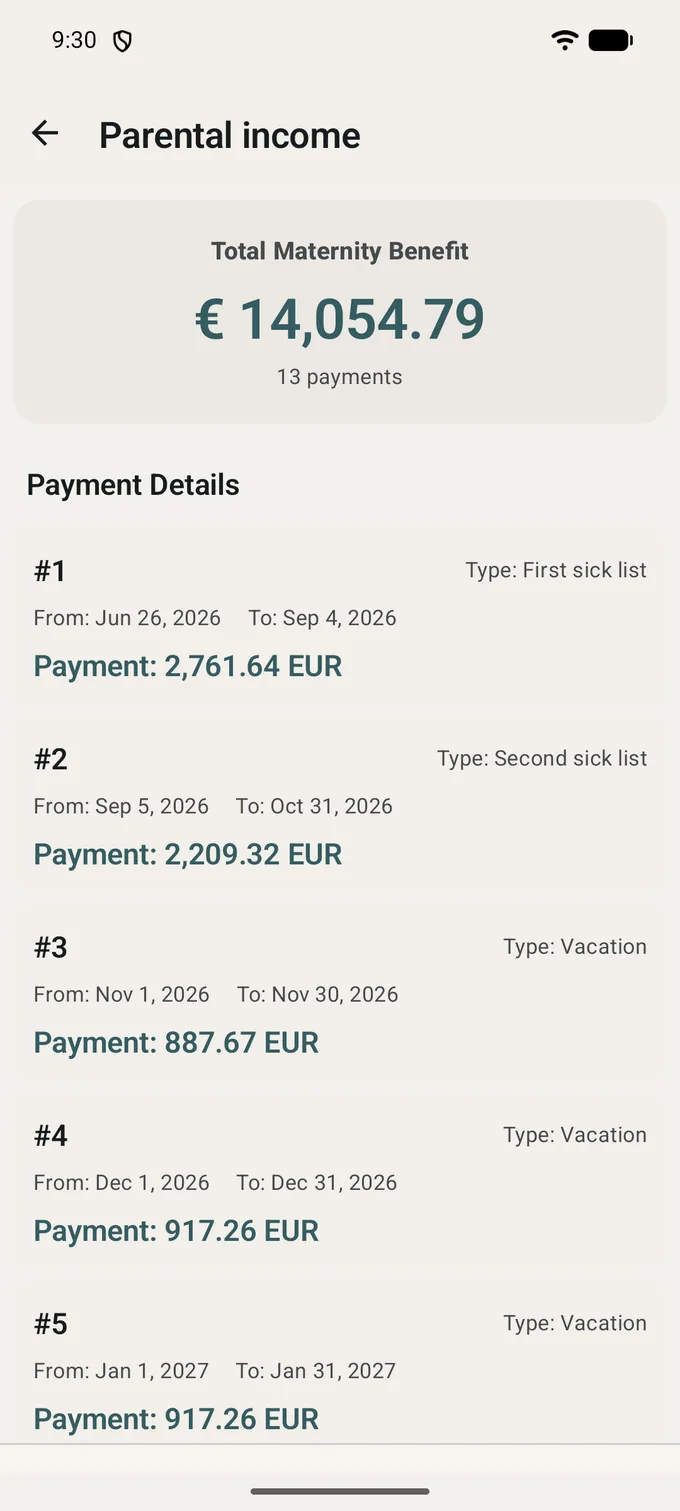
  • What a parent receives while caring for a child, worked out from the contribution base over the period the law counts.
  • The base is what social contributions were actually paid on, which is why a raise last month may not show up in the benefit at all.
  • The app gives you the figure and the breakdown behind it, and nothing else: it is not an application, and nothing is submitted to the VSAA from it.
Sick leave, sheet B

Where the employer stops and the state starts

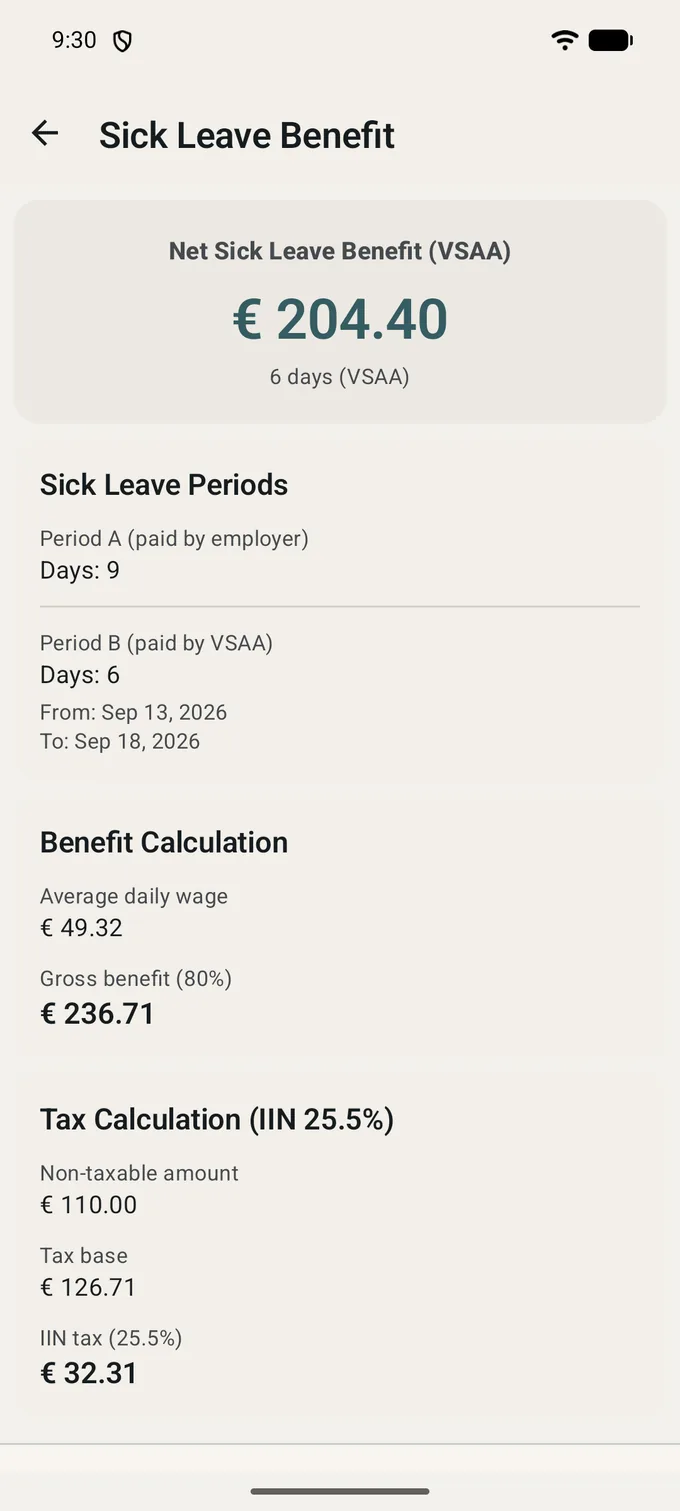
  • Sheet B is the state's share of an illness. It begins where the employer's sheet A ends, and it is a different calculation with a different payer.
  • Average daily wage and the days of illness go in; out comes the benefit at the statutory percentage, and then the same figure after income tax -- which is the number that actually arrives.
  • Sheet A is not calculated as money -- it is the employer's to pay, under different rules -- but its length is part of the input and is shown beside the result, because that is what decides when sheet B starts.

And two more from the same agency

Unemployment benefit

Takes your length of insurance record, because the record sets both the percentage and the way the payment steps down over the months of unemployment. Two people with the same last salary and different records get different answers, and this is the calculator that shows it.

Paternity benefit

The payment to a father around the birth of a child, on the same contribution-base principle as the rest. Short to compute and easy to be wrong about, because the base is again not the salary.

Finance

Two calculators that have nothing to do with Latvian law and everything to do with arithmetic people would rather not do twice. They are here because the person asking what a salary leaves them is usually also asking what a loan takes away.

Loan

The payment, and where every euro of it goes

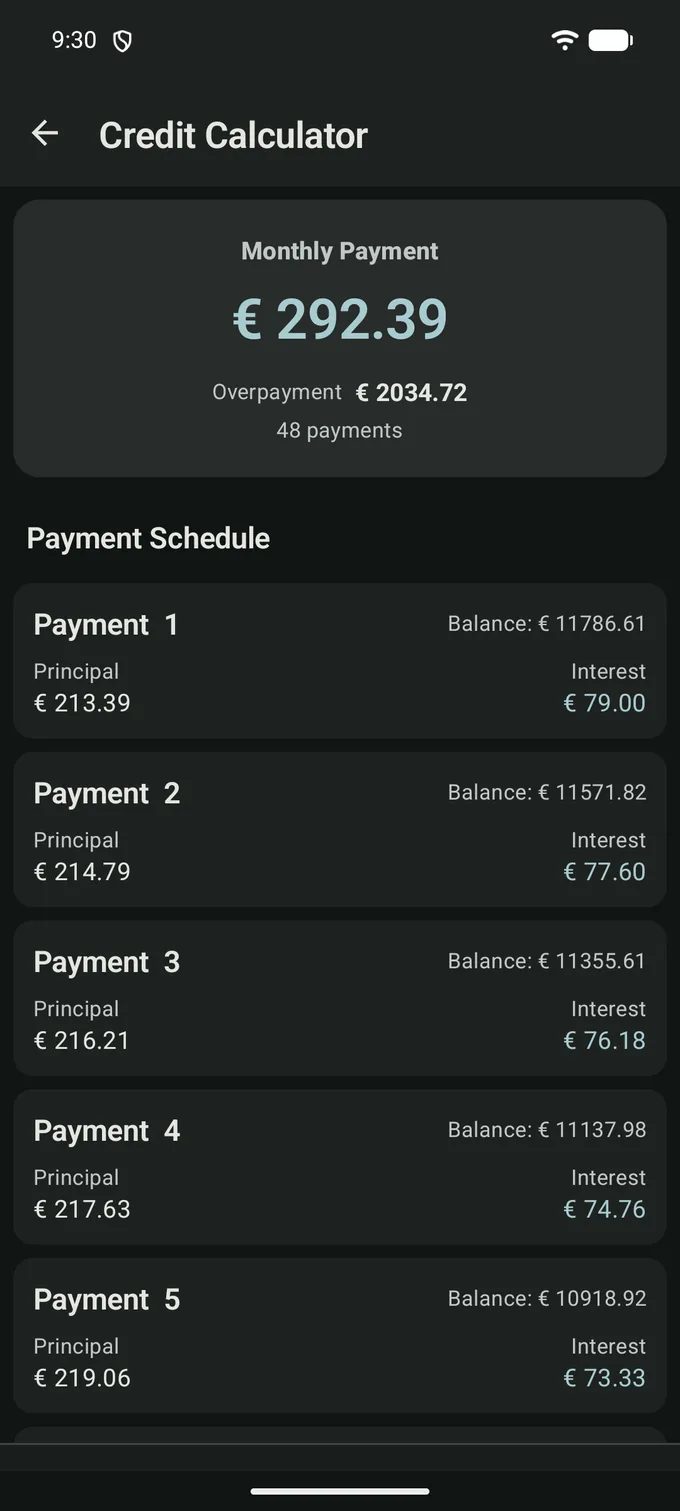
Amount, annual interest rate and a term in months or years. Out come the monthly annuity payment, the number of payments and the total overpayment — and under them the full schedule.

  • For each payment: how much is principal, how much is interest, and what balance is left after it.
  • The schedule is the point. A monthly figure tells you whether you can pay it; the split tells you why the first years barely move the debt.
  • Annuity payments only — equal instalments for the whole term. That is what Latvian banks quote by default, and it is the one the app computes.

Deposit: what saving adds up to

Initial amount, annual rate, a term in months or years, and an optional monthly top-up. Interest compounds monthly.

  • The result separates the final amount, the total you put in and the interest earned, so the growth is visible against your own contributions rather than hidden inside them.
  • No bank's product is modelled and no offer is being made. It is compound interest, computed.

Where the numbers come from

Every rate, threshold and allowance in the app is taken from a published source and recorded next to the calculation that uses it.

  • likumi.lv — the consolidated texts of the laws and Cabinet regulations themselves.
  • VID, the State Revenue Service — the guidance and tables for payroll taxes and the non-taxable minimum.
  • VSAA, the State Social Insurance Agency — the rules for the four benefits.
  • A tax year that has passed keeps the rules it had. The 2019 card computes 2019, and a later reform does not retroactively change it.

Sources can be wrong or out of date, and so can the app. The terms of use say what that means for you, and the app repeats it on the home screen before you calculate anything.

Nine of them, and no account for any of them

Install once. Nothing to register, nothing to buy, and nothing that stops working when you are out of signal.

Get it on Google Play

Free, with ads. Android 6.0 and newer.